
For In-House Lawyers, Attorney-Client Privilege Isn’t a Legal Technicality—It’s a Business Strategy
The role of today’s general counsel looks far different than it did just a decade ago. Corporate legal departments now operate at the center of business strategy, risk management, and decision-making. That evolution brings influence and opportunity along with new risks. Doctrines that protect lawyers and their companies—privilege, work product, and immunity—are no longer background principles. They are frontline tools in high-stakes litigation.
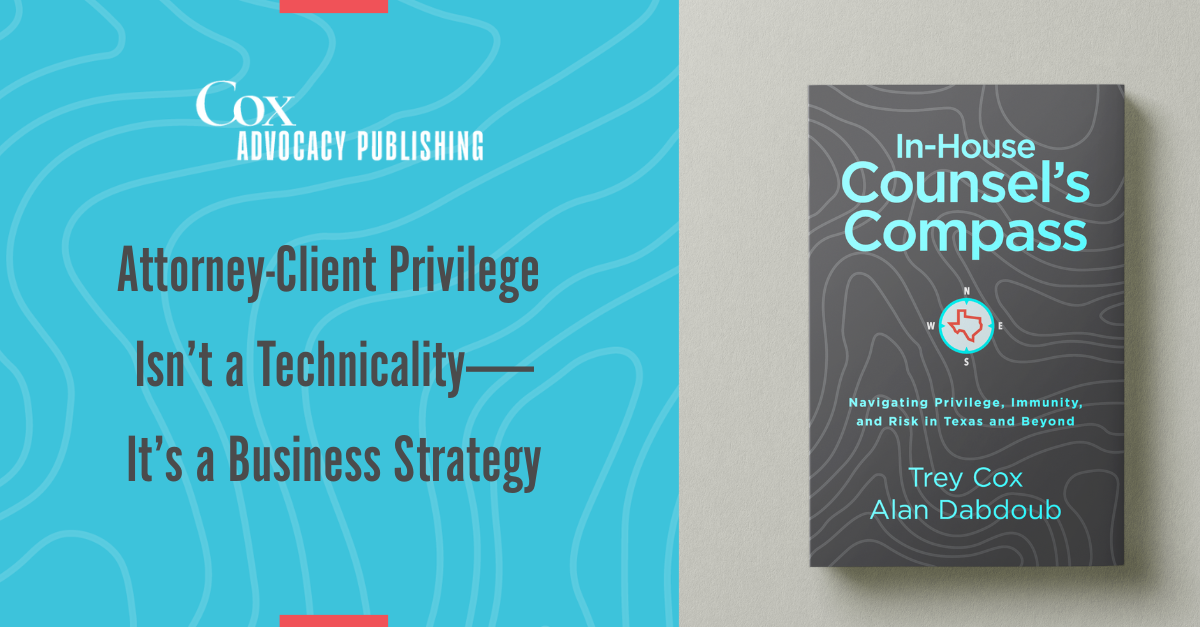
In “In-House Counsel’s Compass: Navigating Privilege, Immunity, and Risk in Texas and Beyond,” co-authors Trey Cox and Alan Dabdoub provide a practical guide for in-house legal departments navigating privilege as the role of inside counsel evolves. The book offers a clear-eyed look at how these protections hold up under litigation pressure and what the authors describe as “the razor-thin line between protection and exposure.”
Cox and Dabdoub write:
For Texas general counsel, attorney-client privilege is more than a legal doctrine—it is a strategic asset. It protects candor, enables sound legal advice, and shields the company in litigation. But precision, consistency, and foresight are necessary to guard privilege.
The best general counsel treat privilege not as a given technicality but with organizational discipline. They train their teams, structure their communications, and enforce their protocols with rigor. Because in the crucible of litigation, privilege is not tested in the abstract. It is tested in the heat of discovery, with every word, email, and memo scrutinized for cracks.
Protect it, and you protect your company. Lose it, and the consequences may be irreversible.
Attorney-client privilege exists to enable candid communication and sound legal advice, but it can be lost far more easily than most organizations realize. Unlike outside lawyers, in-house counsel operate in a dual role—part legal advisor, part business partner. That overlap creates a constant tension over when advice crosses from legal into business? The answer to that question often determines whether a document is protected or becomes evidence.
The most common privilege disputes don’t hinge on whether a document exists, but on whether the lawyer was acting in a legal capacity when it was created. That distinction can turn on subtle details: the language used, the audience included, or the purpose behind the communication.
The takeaway is direct: protecting privilege requires discipline. The best general counsel don’t treat it as a box to check. They build systems around it—training teams, structuring communications, and enforcing protocols that hold up under scrutiny. Because when litigation hits, there is no room for ambiguity.
Strategic Lessons for In-House Counsel
Stay in the Legal Lane
Your title may include “Chief Legal Officer” or “General Counsel,” but your role is not to make business decisions. The broader your footprint is in business execution, the weaker your immunity.Document Your Role
When involved in mixed business and legal tasks, clearly record your role as counsel. Minutes, memos, and emails should frame your contributions as legal advice, not operational judgment.Use Outside Counsel for Risky Actions
When actions push the boundaries—aggressive litigation tactics, contentious disclosures—consider routing through outside counsel. Their role is unambiguously legal, which reduces your risk of losing immunity.Educate the Business Team
Train executives to understand that you advise, not decide. If they see you as a business officer, so will opposing counsel—and courts.