
AI as Evidence: Why General Counsel Must Treat Prompts and Outputs Like Litigation Assets
For chief litigation counsel and general counsel, the real challenge is not whether to allow AI—that’s simply unrealistic at this point in most enterprises—it’s how AI activity is governed, preserved, produced, and ultimately explained under oath. Because in modern litigation, AI prompts, outputs, and usage logs don’t vanish when you X out of the search screen—they are discoverable artifacts that can impact litigation.
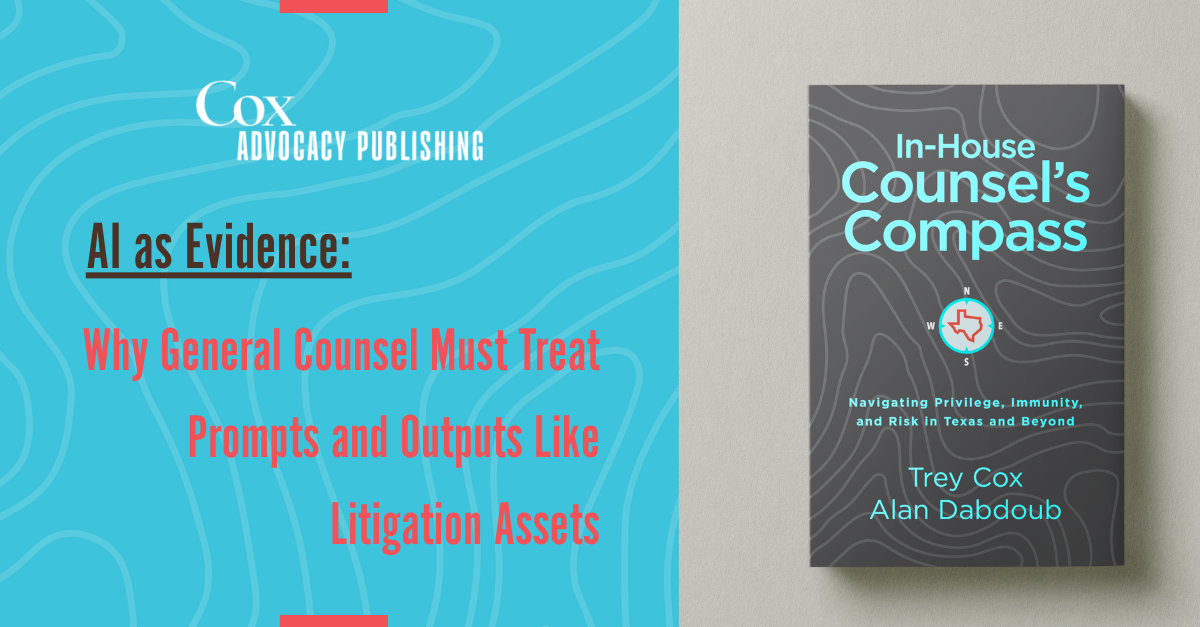
In “In-House Counsel’s Compass: Navigating Privilege, Immunity, and Risk in Texas and Beyond,” co-authors Trey Cox and Alan Dabdoub reframe the risk assessment that comes with AI adoption within an enterprise.
They write:
If you want AI to be a force multiplier in disputes, you can get there. But you do not get there by hoping privilege will clean up after the fact. You get there by designing a litigation-grade system up front—one you would be comfortable explaining to a judge, a jury, and your board without hedging.
***
In high-stakes disputes, theory does not get the last word. Depositions, hearings, and trial do. That is why AI is not a philosophical question for enterprise legal leadership. It is a workflow that generates artifacts. Boards do not care whether a team used AI. Boards care whether the company lost control of its story.
To put it bluntly: AI is going to be treated like evidence because it is evidence. And when it intersects with privilege and work product, courts are already applying familiar doctrines in ways that can surprise teams who assumed AI was closer to “thinking” than “writing.”
Governance is more than a written policy. Governance is training, tooling, and enforcement. If your policy says “don’t input sensitive information,” but your employees can access consumer AI tools on their phones and your vendors retain logs, you do not have a policy. You have a memo.
***
Litigation leadership is not measured by the elegance of a brief. It is measured by whether the enterprise can make hard decisions quickly, credibly defend its process, and control cost and tempo without giving away leverage.
AI is now part of that discipline.
The practical shift is to treat AI use as record creation, not private thought. When you do that, the operating model becomes clear: lane discipline, tool control, retention choices, counsel protocols, and a board-level reporting rhythm that surfaces issues early.
Courts will not give companies a grace period because the technology is new. The doctrines are old. Work product can protect attorney mental impressions, but waiver can be triggered when investigations are used as evidence and fairness demands context. Communications routed through third-party platforms invite adversarial arguments that confidentiality was lost and privilege never attached.
If you want AI to be a force multiplier in disputes, you can get there. But you do not get there by hoping privilege will clean up after the fact. You get there by designing a litigation-grade system up front—one you would be comfortable explaining to a judge, a jury, and your board without hedging.